


Ever Wonder How Pro Padel League Franchises Are Built?

Scott Matulis
Las Vegas Smash Owner Alejandro Hernández Lays It Out
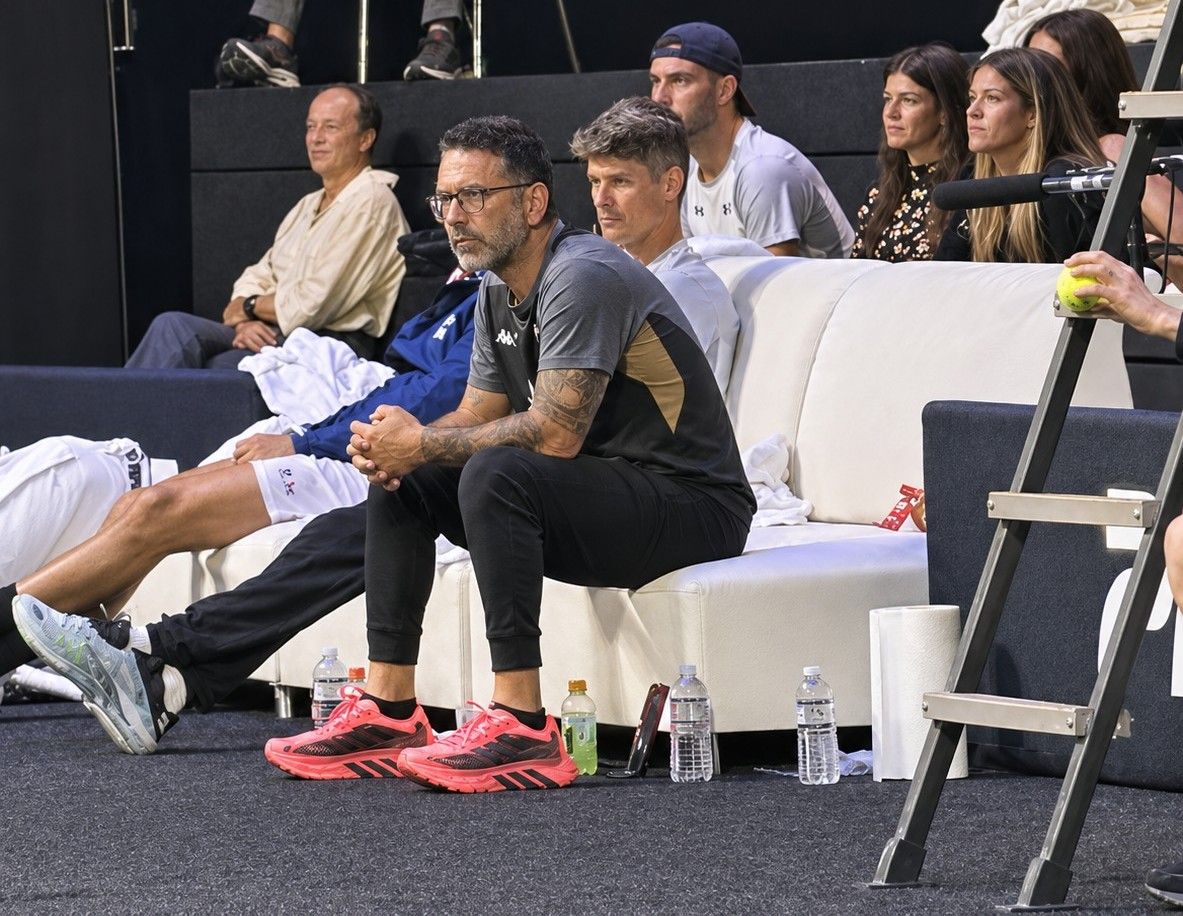
If you are in Las Vegas this week for the Pro Padel League’s final regular-season event, you’ve probably seen Alejandro Hernández on the bench coaching and supporting his team, the Las Vegas Smash. He is both a co-owner and coach/team manager of the Smash and takes an active role in scouting, recruiting, signing and compensating players. I asked him if he would have a chat and explain the ins and outs of owning a PPL franchise.
Q: Give me a little background on yourself and how you got involved with the Smash.
Alejandro: I'm originally from Mexico. I was born in Mexico City. I've lived in Las Vegas for six years now, almost six years. But as you probably know, padel started in Mexico. We just didn't commercialize it, I guess. We didn't grow it, but we created it. So I'm biased and proud of that. You mentioned earlier, how many padel players were college tennis players. I'm one of them, actually. I played Division I at Morehead State University. It's a smaller D1 school in Kentucky. But I've always been exposed to and around padel because I grew up in Mexico.
So, my brother actually called me four or five years ago, and he saw the growth of padel in Mexico, but also outside of Mexico, and he's an entrepreneur. He owns restaurants, and he called me out of nowhere and asked me, hey, let's invest in padel. Let's find a way to invest in padel.
Ironically, the founder of the league, back then, Marcos del Pilar, was starting the PPL. I bumped into Marcos and we connected.
There was a group of investors out of Canada that were looking to buy a franchise. Those guys specifically have a lot of love and passion for Vegas. I live in Vegas, so it was the perfect marriage, if you will. I needed some partners and investors. They needed somebody local who knew the sport. We met a few times, and then we made it happen. We bought the franchise, and here we are four years later.
Q: What does it cost to buy a franchise in PPL?
Alejandro: Well, nowadays I don't know. But back then it was about a quarter of a million dollars, if I remember correctly. But now it's very different.
Q: What do you do for a living here, other than being the owner of the Smash?
Alejandro: I mean, medical devices, that's how I pay my bills. Padel is how I spend my money. Medical devices are how I make my dreams.
Q: So tell me about your team. How connected is the Smash to the Las Vegas padel community?
Alejandro: Yeah, so the Las Vegas padel community, in my opinion, is still relatively small compared to some of the bigger markets in the U.S. Miami, for example, even San Diego, LA, we're below that type of market. Miami is probably the capital of padel here in the U.S. So Las Vegas, we only have one padel club right now. It's called P1 Padel. We're super excited. There's a second club opening within the next couple months.
Q: Where do you get your players for the Smash? What's the process you go through?
Alejandro: Yeah, so I've been doing this for the team for four years. I spend a lot of time researching.
Q: What type of research? Tournament results?
Alejandro: The answer is from everywhere. I'm looking for basically a couple things. One, obviously, their performance on the court. I don't pay a lot of attention to rankings. I mean, if you go back and look at the rosters that I've had, with a couple of exceptions, I haven't had top 10 players. Marta Ortega was the exception a couple seasons ago. She was my highest-ranked player ever. But I always try to find the character of the person as an individual, as a human being, and also, how do they play on the court? And what I mean by that is how hard do they work? How hard do they play? To me, the heart, the passion, you cannot train that. It's either you have it or you don't. So I find the players that show me, while obviously following them for months, or maybe even years, I follow them and I pay attention to how they play, their style of play.
And then I try to find people that I believe will play well together. Sometimes I get it right, sometimes I get it wrong. But I think, for the most part, we've been able to build teams that are very cohesive, build friendships that hopefully will last a lifetime.
Q: And what's the business relationship between the players and team? Do you hire them for a match or is it for the whole season?
Alejandro: Oh, that's a good question. So before this season, we would sign players per event. Now, I don't think I've ever signed a player for one event. So it depends on their schedule. I sign them for two, three, four events. And that's what we've done. As you know, in 2027 the league is changing a little bit. So I embraced some of the new rules that are coming in 2027.
So if you look at my girls' team this season, they are signed by event. So Raquel and Jimena, every event that they play, they get paid the amount that we agreed upon. But the boys, Agustín and Guille, are signed for multi-year contracts. So they're with us full time. They're here obviously in 2026. They'll be with us for 2027 and possibly even 2028.
So now we've shifted our strategy with the boys this year. We're monitoring to see how it goes, and I'm gonna adopt the same thing for 2027. The girls that I pick will be from the draft. Most likely I’m going to sign the girls for a couple years at least.
Q: How does the draft work?
Alejandro: So, the structure of the draft has changed a little bit. First of all, the draft for the 2027 season will take place around February. I don't know if we have a specific day, but it's going to be at the beginning of 2027. Number one. Every team will be required to have, after the draft, obviously, a complete men's team, which consists of 2 players, and a female team, which consists of two players. Up to six. So minimum roster, two per gender, maximum roster, six players total.
The actual draft, just like any other draft, will take turns to determine the order. I'm guessing it's gonna be random. And normally, historically it has been “snake,” meaning the one that starts, the number one draft pick, ends up with the last draft pick in the next round. So that's one rule.
And then it involves a bidding process. So that's where it gets a little tricky, and it's different than any other draft in any other professional league in the U.S.
So, for example, if I draft you, and I offer whatever, right? Another team, if they're interested in you, the bidding process begins, and they can offer more. And then there's a bidding war potentially, and the highest bidder basically takes that player.
So that in a nutshell is how it's going to work.
Q: What are the league rules that you have to operate under?
Alejandro: There's a salary cap that the league is still discussing for 2027. This year is a little bit, again, hybrid, so the salary cap applies in 2 different ways, for drafted players and also outside-of-the-draft players.
But next year we'll see. The league will announce the salary cap. They haven't announced it yet. But there will be a salary cap. The teams have the liberty to decide how to spend that money. Let's say, to give an example, if the salary cap is $200,000, I have the liberty to spend $100,000 on girls, that's $100,000 for the boys. Or $150,000 for the boys and $50,000 for the girls. I have a daughter, and I'm passionate to support girls' sports, girls' teams. That's one of my big initiatives. So, historically I've spent way more on the girls' team. I think they have a better return on investment.
Q: Why do you say that?
Alejandro: Well, I think the level of competition for guys is so deep, meaning if they're ranked number 50th in the world they can compete against top 20 players. For the girls, it's different. The depth is less. So, to me, it's wiser to invest in girls more, because if you're lucky enough to have a great girls' team, they have more chances to win more often. Raquel and Jimena made it to the finals in Playa del Carmen. We lost the final, unfortunately, but we made it to the finals. They're coming back from, I think it was Dubai last week. They made it to the quarterfinals. So they're playing really well. I hope that we can get to the final this week at home.
Q: You guys have your work cut out for you, right? If you don't do well, you're out for the final in Miami.
Alejandro: Right. It's that simple. I need the boys to win every single point, and I'm not exaggerating. Every single point, every single game, every single set, counts towards something.
