










France 1998 World Cup: A Stage of Giants and Drama
Segment Spotlight: Quick Hits From Football's Greatest Stage
The Giants of France '98: A Look at the Tournament's Iconic Figures
The 1998 FIFA World Cup in France was notable for several reasons. It marked the first time that the World Cup tournament expanded to include 32 nations. Mirroring this expansion, the opening ceremony in Paris was a spectacle of grand proportions, featuring a parade with four gigantic figures named Ho, Romeo, Pablo, and Mussa. Each represented one of the four colors of humanity, starting at different points in Paris and converging symbolically at the Place de la Concorde. The ceremony was rounded out with performances by jugglers, acrobats, dancers, and contortionists.
Amidst the grandeur and celebrations, the tournament highlighted strong personalities whose stories captivated the audience worldwide. Notably, Paul Gascoigne, referred to as Gaza, was widely discussed even though he did not participate in the tournament. In 1990, Gascoigne had significantly contributed to England reaching the semi-finals of the World Cup. However, by 1998, his struggles with discipline and personal issues had eroded his reliability, leading England coach Glenn Hoddle to exclude him from the squad. This decision caused a media uproar and accelerated Gaza's decline. After learning he was cut from the squad, Gascoigne infamously trashed Hoddle's room in Spain and never played for England again.
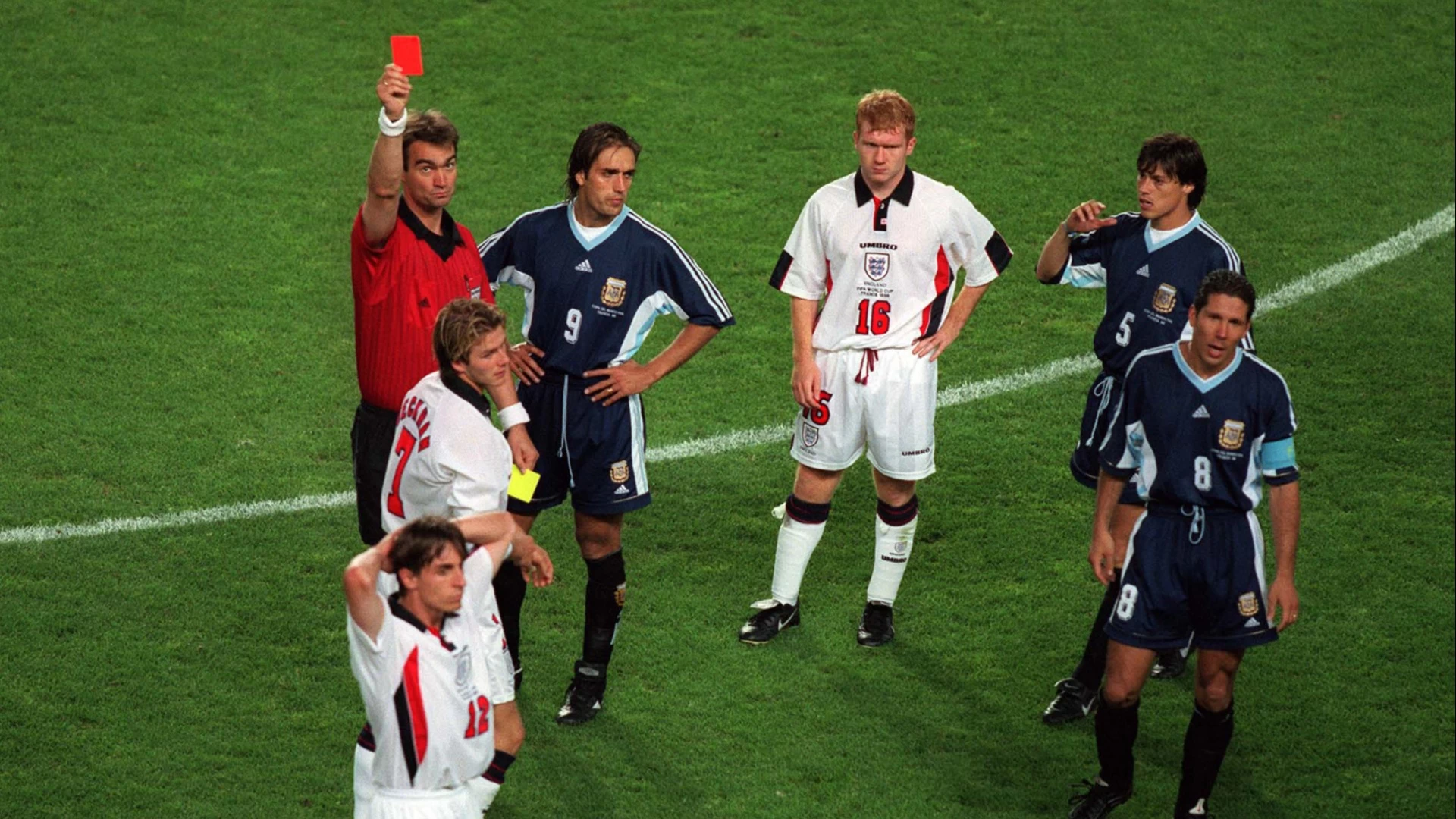
David Beckham, another prominent figure during the tournament, was already a star in the Premier League but was still solidifying his international reputation. Despite participating in all qualifying matches, Hoddle initially questioned Beckham's focus due to immense media attention surrounding his engagement to Spice Girl Victoria Adams. However, after sitting out the first two group matches, Beckham played against Colombia, scoring from a free kick which proved pivotal in advancing England to the knockout stages. Unfortunately, Beckham's journey took a dramatic turn in the next match against Argentina. After being fouled by Diego Simeone, Beckham's mild retaliation resulted in a red card, reducing England to ten men. The team fought valiantly but ultimately exited the tournament on penalties. Despite initially defending Beckham, Hoddle later criticized him, which, according to Beckham, fueled extreme backlash against him, including death threats from fans.
The 1998 World Cup thus remains memorable not only for its football but also for the dramatic human stories that unfolded. These stories, of rises and falls, triumphs and defeats, continue to resonate as reminders of the intense pressures and high emotions associated with football's greatest stage.






BETTING NEWS
FUTURES

