


Derek Stevens built Circa for sports fans and then he gave them a reason to keep coming back
Arash Markazi
Host · Writer
LAS VEGAS — The first time I remember talking to Derek Stevens about Circa, we were standing at a construction site in downtown Las Vegas. He was describing a place that didn’t exist yet, pointing toward a future where the sportsbook wouldn’t be something tucked into a casino but the reason people traveled across the country to visit it.
When I found him recently, he was in a cabana at Stadium Swim, surrounded by employees from his sports, risk, marketing, business development and operations departments. They were drafting a fantasy football team in the inaugural Legacy League, which carries a $100,000 entry fee. The enormous screen overlooking the pools had become a draft board, and the man who built the place was doing exactly what he had envisioned years earlier: watching sports with his friends.
“I’ve been playing fantasy football since I’ve been 14 years old,” Stevens told me. “We’ve never been in anything like this. This is crazy.”
There are more elaborate ways to explain Circa’s business model, but that scene comes pretty close. Stevens built a place where he wanted to spend his Sundays and figured other sports fans might want to join him. The screens and pools get their attention. The feeling that they have been invited into something keeps them coming back.
“We hang out, we work every Sunday together,” he said of the group helping assemble his fantasy roster. “We watch a lot of football.”
Stevens fell in love with Las Vegas as a University of Michigan student visiting between a summer job and his return to campus. He eventually made the city home, building a downtown casino business with his brother, Greg, through the Golden Gate and the D before taking on their most ambitious project.
When I visited the Circa construction site in January 2020, the resort was supposed to debut that December. We all know what happened between those dates. A development built around bringing people together was preparing to open as the world was being told to stay apart.
Circa nevertheless opened its casino and major attractions that October, followed by the hotel in December. The first new downtown resort-casino built from the ground up in four decades arrived during one of the most uncertain periods in Las Vegas history.
Stevens’ vision had been clear long before that uncertainty.
“What we’re building is going to be the mecca of sports betting,” he told me during construction. “I wanted everyone around the country to know we have a destination sportsbook.”
He wasn’t simply trying to build a better place to make a bet. He wanted to compete with the experience of attending the game itself. As a Detroit sports fan, he understood both the appeal of being there and the aggravation that could accompany it.
“I think watching the NFL on television is a far better experience than going to the game,” he told me then. “I went to the Lions game on Thanksgiving Day and it was a seven-hour ordeal when you talk about traffic, parking, security lines and everything else. That’s not including the in-game experience where you don’t get all the replays and the commentary and you’re in line for an hour to get something to eat or drink.”
His answer was a three-story sportsbook with a 78-million-pixel screen and viewing capacity for 1,000 people. Upstairs, Stadium Swim paired six pools with a massive outdoor screen and room for 4,000. These weren’t amenities added to accommodate sports fans. They were the point of the property.
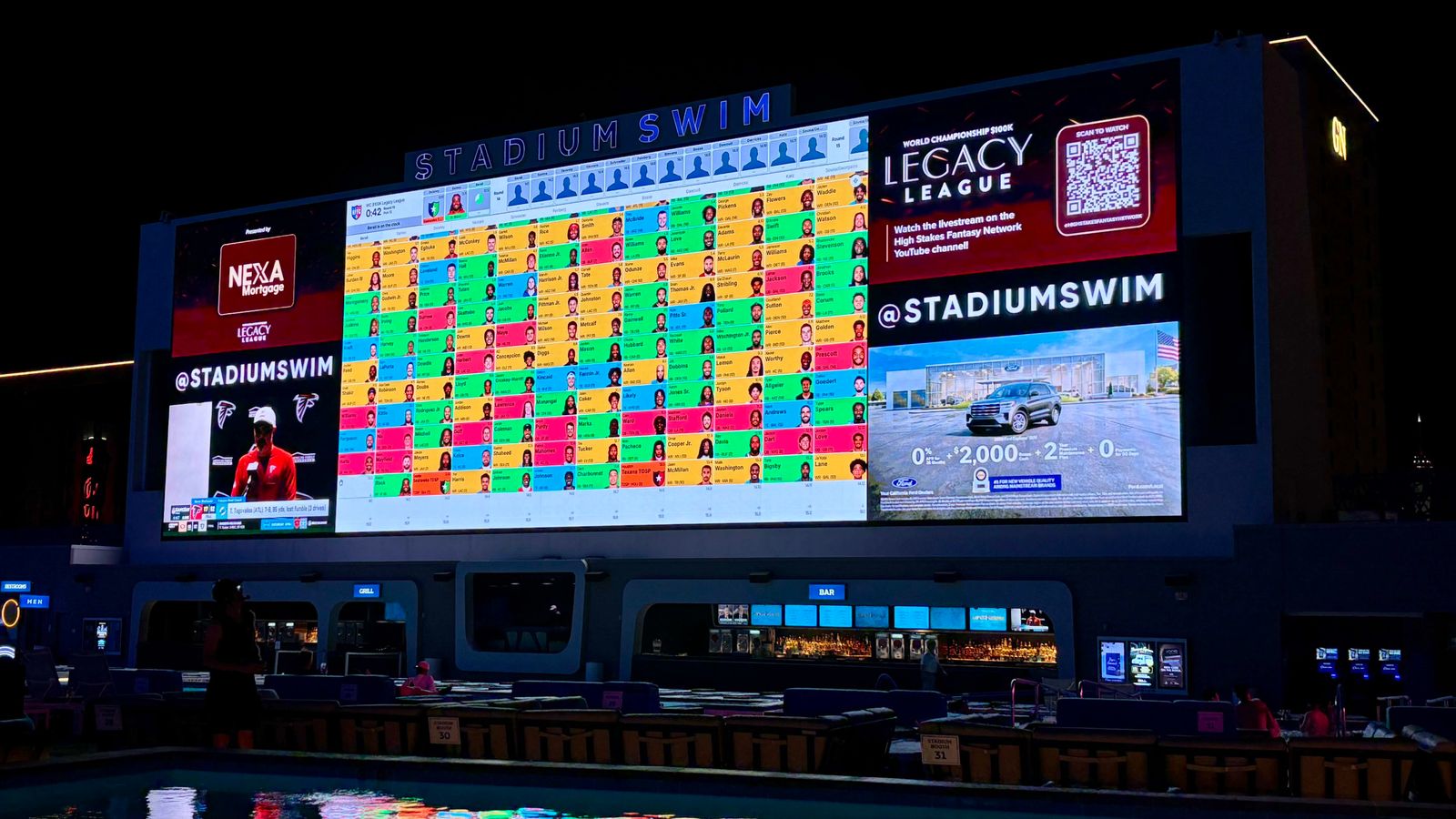
The scale is what people photograph, but the smaller details reveal who built it. Mike Palm, the vice president of operations for Circa, the D and Golden Gate, told me how much time they spend discussing television programming in the hotel rooms and cabanas. Regional sports coverage matters. So does allowing a group in a cabana to hear its own game even when a different broadcast is playing across the pool deck.
“Derek built this for himself as a customer, right?” Palm said. “That’s the way he built it. How would I enjoy it? As a sports fan and as a gambler, how would I enjoy this experience?”
That doesn’t mean Palm agrees with every idea. Stevens originally wanted sports audio playing at Stadium Swim around the clock. Palm reminded him that someone renting a cabana on a Thursday morning might not want to spend the entire day listening to the Rays play the Orioles. There was still a place for DJs and music between the major events.
Stevens adjusted. On another idea, Palm was the one who needed convincing.
When Stevens proposed Grandissimo, a survivor contest with a $100,000 entry fee, Palm worried they were taking something that already worked and pulling customers away from it. Stevens believed it would attract a different audience. The inaugural contest drew 69 entries and a $6.9 million prize pool.
“I was the one pushing back,” Palm said. “He goes, ‘There’s a whole different clientele,’ which he’s right.”
The Legacy League draft was another expression of that thinking. Stevens wasn’t asking everyone who entered a $1,000 football contest to suddenly find another $99,000. He was giving another group a reason to come downtown.
“There’s a lot of people that have never been down here today,” Stevens told me during the draft. “They’re loving this.”
Earlier, he had been meeting fans arriving for contest sign-up weekend, an event that has become its own gathering on the football calendar. Palm described three days of programming, from a champions dinner and time together at Bar Canada to Stadium Swim events and a panel discussing the upcoming season. Radio and podcast participation, he said, had grown from roughly a dozen outlets to more than 40.
The contests now offer $30 million in combined guarantees: $20 million for Circa Survivor, $6 million for Circa Million VIII and $4 million for Grandissimo. Survivor costs $1,000 per entry and requires contestants to select a winning NFL team for each contest leg without using the same team twice. Million VIII asks for five weekly picks against the spread, while Grandissimo applies the survivor concept at its six-figure entry price.
Last season, five winning Survivor entries split $18,718,000, receiving $3,743,600 apiece. Those numbers explain some of the interest, but Palm offered a smaller story that stayed with me: a young man from Kansas who saves to purchase one entry each year and schedules his trip around sign-up weekend so he can spend time with the people running the contest.
A $1,000 entry is a substantial expense, and for most contestants the season will end without a payout. What Circa can control is whether the visit feels worthwhile beyond the pick sheet.
Palm said contestants came from 31 countries last year. In-person registration brings them to Nevada, while registered proxies allow them to submit picks after returning home. He had recently met a man from New Zealand who flew in to enter.
“It’s turned into like a pilgrimage to Las Vegas, a pilgrimage to the desert,” Stevens said. “And they’re all coming out here to sign up.”
There is a deliberate business calculation behind the hospitality. Circa takes no rake from the contests, and Palm estimated that putting on the three competitions costs the company $7 million in marketing, labor and other expenses. The wager is that people who make the trip will like the properties enough to spend time there and return.
“But it’s a bet that we can get people to our property and they’ll love it,” Palm said.
Stevens is a throwback in a city where the person who owns the casino can feel far removed from the person visiting it. You see him around his properties. You can talk to him. On this night, you could interrupt his fantasy draft long enough to ask about the place, although there was always another player coming off the board.
Palm views that accessibility as part of the product, whether it means meeting Stevens or reaching someone who can resolve an account problem.
“I think it makes a difference when people are choosing,” Palm said. “That they feel comfortable that they’re actually working with a person.”
The success has inevitably attracted imitators. Stevens seems comfortable with that outcome. A concept this conspicuous was either going to struggle or work well enough that other operators would want their own version.
Palm draws a distinction between inspiration and copying. He said the company had sent a cease-and-desist letter to an unnamed operator over what he considered an overly close imitation. He declined to identify the business. But he also acknowledged that Circa looks at successful promotions elsewhere and considers how to put its own spin on them.
The more interesting question is how much of Circa can actually be duplicated. Another property can install a screen above a pool. It is harder to reproduce the relationship between a place and the people who have made visiting it an annual tradition.
Stevens believes the pandemic helped accelerate the desire to watch sports together. After so much isolation, friends wanted trips with friends. They wanted a place to cheer, argue about a call and spend a weekend with people they might otherwise only see in a group text.
That is what I thought about watching him in the cabana. In January 2020, he could explain the dimensions of the sportsbook and describe the pools. What he couldn’t show me yet was the gathering that would eventually fill them.
Near the end of our conversation, Stevens talked about what it means when someone gives his property 48 hours. The visit represents much more than two days, he said. There are weeks of planning, money spent on travel, children who need rides to practices and arrangements that have to be made before anyone boards a plane.
“They’re doing it all just to spend 48 hours here,” Stevens said. “So I’m a big person that preaches the fact that in the 48 hours that a customer is going to give us, it’s our responsibility to give them the time of their life.”
Years ago, standing at a construction site, I listened to Stevens explain how he would build a destination sportsbook. Sitting with him at Stadium Swim, I heard the more important part of the plan.
He knows the screen can get people to look. Making them feel welcome is what gets them to come back.