


Inside the life of the real Jerry McGuire

Eric Lambkins II
Host · Writer
As the sun waltzes across the face of a clear, blue sky, waves clap against the shore of the California coastline like an ovation at the Oscars.
The view from Leigh Steinberg's Newport Beach office stretches across the Pacific like eternity's neighbor.
It's the kind of view that costs money. The kind Steinberg used to take for granted.
But Steinberg is a modest man now.
No Rolex. No flash.
Just a man who has been to the mountaintop, fallen off the cliff, and spent the last 15 years climbing back on his hands and knees.
A Patrick Mahomes Wheaties box sits behind his left shoulder. A diminutive USC Trojan helmet. Pictures of Tom Cruise and Cuba Gooding Jr. show that the storage space above his head is jam-packed with books. Seven figurines of Yoda and Grogu, a signed basketball and a small collection of Cal Berkeley keepsakes are sprawled across the desk.
Self-deprecation is how he handles the wreckage.
The bankruptcy. The DUIs. The divorce.
The moment he let his NFLPA certification lapse was because he couldn't get his life straight.
The storage lockers full of memorabilia—photos with four presidents, signed helmets, magazine covers featuring a young Steve Young—all sold off by a bank while he was in rehab.
"I could live in a ramshackle hovel," Steinberg said, "as long as it had a view of the ocean."
He is now 77 years old, having been sober for over 16 years.
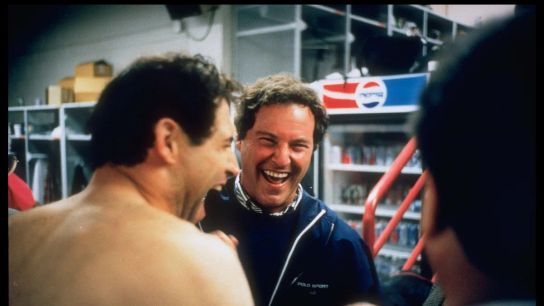
He still represents Patrick Mahomes. He still hosts the Super Bowl party he started in 1988—the 40th edition will be held in Los Angeles in 2027.
Courtesy of Leigh Steinberg
He's still writing books. His third one, "The Comeback: Resilience, Empathy and What Matters," just came out.
And still, after all of it, he is one of the most honest voices you'll hear in sports.
"Life will have reverses for all of us," Steinberg said. "It could be as dramatic as substance abuse, or it could be romantic relationships or financial problems. Life is going to have junctures where we're unhappy about the place we are in the world. The question is not whether that's going to happen; it's inevitable. It's how you respond."
That question—how you respond—is the thread that connects Steinberg's life to the city that made him. Because right now, Los Angeles is answering that same question. And the answer is spectacular.
The Three-Year Run
No city in modern sports history has ever done what Los Angeles is about to do.
The FIFA World Cup began June 12 at SoFi Stadium, with Team USA opening its campaign in the first of LA's eight matches. The Super Bowl returns to SoFi in 2027. The Summer Olympics arrive in 2028.
Three years. Three global events. Unprecedented. Impossible. And yet, happening.
Steinberg ticks off the inventory of Los Angeles sports teams with practiced ease.
"We have, like Noah's Ark, two of every professional team. Two hockey teams, two soccer teams, two baseball teams, two football teams, two basketball teams. We also have two major athletic universities in UCLA and USC who are always near the top. This is the cutting edge, the vortex of where sports come alive."
He pauses and lets it land.
"It's Southern California center stage hosting in front of the whole world. The biggest sporting event in America, which is the Super Bowl. The biggest sporting event in the world, which is the World Cup. And the biggest event in world athletics, the Olympics. To have them come so quickly elevates Southern California into the central role of being the biggest sports city in the world at this point."
Steinberg has watched this transformation unfold his entire life. Born in Los Angeles in 1949, he saw the Dodgers play their first game in the city in 1958.
He's watched this town lose teams, gain teams, bury teams, and resurrect them. His grandfather and George Burns took him to his first baseball game—the Hollywood Stars versus the LA Angels in the Pacific Coast League.
"There was no pro basketball team and one pro football team," Steinberg recalled. "Now it's expanded. We have two of every professional level, plus UCLA and USC. Plus an amazingly well-developed talent pool in high school sports."
And where do they play these games?
At SoFi Stadium, which Steinberg calls "state-of-the-art." At the Clippers' brand-new arena. At facilities that didn't exist when he was a kid.
"The biggest building in Southern California was City Hall and it was 15 stories," Steinberg said. "Oh my God, you could see all across the city because it was flat. To be part of the growth and change and development—I couldn't imagine being born and living anywhere else."
The Education of an Agent
Steinberg's parents—a teacher and a librarian—raised him with two core values.
"One was treasure relationships, especially family," Steinberg said. "The second was try to make a meaningful difference in the world and help people help themselves."
Those values became the foundation of a career that would redefine sports representation.
Over five decades, Steinberg has represented more than 300 professional athletes.
Eight No. 1 overall NFL draft picks. Sixty-four first-round NFL picks. Twelve Pro Football Hall of Fame inductees. 30 first-round MLB players.
Courtesy of Leigh Steinberg
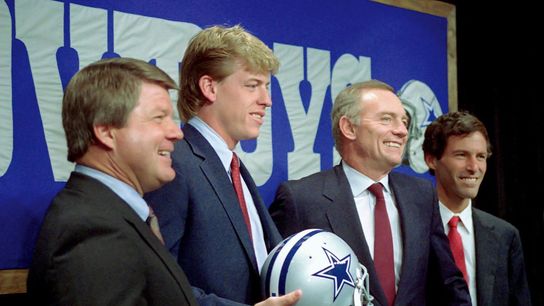
Leigh Steinberg celebrates the draft of Troy Aikman with Cowboys owner Jerry Jones and head coach Jimmy Johnson.
Five NBA first-round draftees. Boxers like Lennox Lewis and Oscar De La Hoya. Olympic athletes like gold-medal ice skater Brian Boitano and gold-medal gymnast Kerri Strug. The United States National Team in the 1994 World Cup.
But the numbers only tell half the story. The other half lives in the relationships.
"One of the keys was listening skills," Steinberg said. "Being able to draw out another human being cut below the surface. Men very often don't share quite as easily their intimate feelings as women do. So you have to create an atmosphere of trust. Being able to put yourself in another person's heart and mind and see the world the way they see it allowed me to establish trust."
That trust became the currency of his career.
He negotiated more than $4 billion in contracts and helped athletes understand that their platform could be used for more than just endorsements.
"I saw that athletes could use their high profile to make a difference in the community around them," Steinberg said. "If they'd go back to the high school and set up a scholarship fund or work with the Boys and Girls Club or church, they could retrace their roots."
The numbers are staggering.
Athletes Steinberg has represented have raised almost $1.3 billion for charities.
Warrick Dunn's Homes for the Holidays has put 220 single families in their first homes.
Patrick Mahomes' "15 and the Mahomies" foundation helps at-risk kids, children in hospitals, kids struggling to find enough to eat.
"Sports can have a ripple effect on other things," Steinberg said. "Having Lennox Lewis, the heavyweight champ, do a public service announcement that says 'real men don't hit women' could do more to trigger behavioral change in rebellious athletes than a thousand authority figures ever could."
The Real Jerry Maguire
Cameron Crowe followed Steinberg around for two years.
He went everywhere Steinberg went. He heard every story. And then he wrote a movie.
Jerry Maguire. Tom Cruise. Cuba Gooding Jr. "Show me the money."
"I was technical advisor," Steinberg said. "I had to vet the script to make sure the willing suspension of disbelief that holds you in a motion picture didn't get shattered. That the dialogue was on point. That the look on the set was right."
The film humanized sports agents, Steinberg believes. It showed the real caring that goes into these relationships.
Crowe once told Steinberg something he's never forgotten: "Jerry Maguire aspires to be you."
Courtesy of Leigh Steinberg
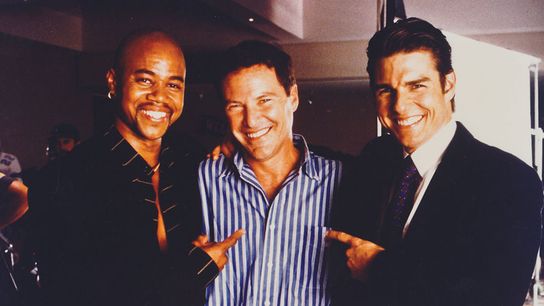
Leigh Steinberg on set of the film Jerry McGuire with Cuba Gooding Jr. and Tom Cruise.
That was before the fall. Before the arrests. Before the bankruptcy. Before the long, lonely, arduous climb back.
"Jerry Maguire is a fictitious character," Steinberg said. "Obviously it doesn't make a very good movie if you start with the first pick in the first round of the draft and do the biggest contract. That doesn't show you much growth or much of an arc of transformation."
The real arc belonged to Steinberg. And it was far messier than anything Hollywood could script.
The Fall
Steinberg's alcoholism was a disease that told him he didn't have a problem.
"Everyone around you may be telling you you have a problem," Steinberg said. "But until you embrace the first step of the 12-step program that says you're powerless over the substance and your life's become unmanageable, you can't take the action necessary to recover."
He went to a 12-step program. Got a sponsor. Found a home group.
Worked those steps like his life depended on it—because it did.
"Once I realized how out of control I was, I had an epiphany," Steinberg said. "I'm sitting on my deceased father's bed in our family home, having shut down my condo, shut down my practice and given it to the younger agents. My only thought at one point was, 'Where could I find more vodka?'"
The epiphany came in the form of proportionality.
"I wasn't a starving peasant in Darfur or Somalia," Steinberg said. "I didn't have the last name Steinberg in Nazi Germany in the '30s. I wasn't sick in any fundamental way other than emotionally. What excuse did I have not to live up to what I was hardwired to do, which is make a difference in the world?"
The book he wrote about the experience is brutally honest.
Unflinching. Raw.
"The bottom line of 'The Comeback' is that if there are other people still struggling, if they're filled with confusion and darkness and have lost their way, can I help give them some advice that gets them back?" Steinberg said. "Can I help other people?"
He pauses and allows the weight to settle.
"That was raw. There were parts of it where, oh my God, what am I doing? But at the same time, it's only by being completely transparent that other people can identify and hopefully find some hope and solution in their own situations."
The Concussion Advocate
Steinberg had a crisis of conscience in the 1980s.
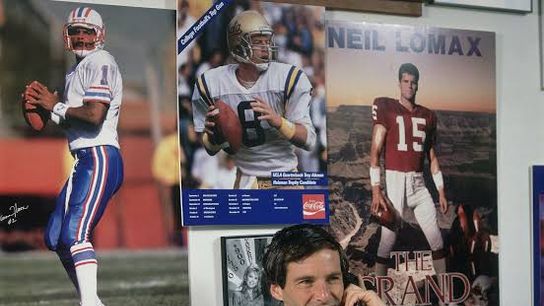
He was representing half the starting quarterbacks in football. They kept getting hit in the head.
Courtesy of Leigh Steinberg
He went to doctors and asked: "What are the long-term implications? How many is too many? When should we contemplate retirement?"
"They had no answers," Steinberg said.
So Steinberg did something unprecedented. He held the first concussion conference in 1994.
Troy Aikman attended. Steve Young. Warren Moon. Drew Bledsoe.
A room full of the most recognizable faces in football, listening to experts explain the dangers they were facing.
"We keep doing the same thing," Steinberg said. "We found that three or more concussions is the number. After that, you have an exponentially higher risk of Alzheimer's, Parkinson's, premature senility, chronic traumatic encephalopathy and depression."
He called it "a ticking time bomb and undiagnosed health epidemic."
"It's one thing to know that football breaks down joints and someone who turns 45 and bends over to pick up their child will have aches and pains," Steinberg said. "It's another thing not to identify that child. In other words, you're talking about the brain."
Recently, Steinberg established a concussion foundation bearing his name.
Its mission: "advancing the understanding, prevention, and treatment of concussions, traumatic brain injuries, and other brain health challenges."
The foundation supports emerging approaches such as rTMS (repetitive transcranial magnetic stimulation) and neurofeedback, which can help heal a concussed brain through neuroplasticity.
"We also try to provide treatment for underserved communities that don't necessarily have a way to deal with brain health," Steinberg said.
The problem, he explained, is that players have been acculturated in denial.
"They've been taught to ignore pain and to be stoic. This play becomes everything. They'll tell you, 'You don't understand. I have to play this game. I cannot lose my position in starting order.' It's denial. You have to do your best to get people to think about their long-term health future."
The Comeback
Steinberg's recovery wasn't a single moment. It was a thousand small decisions.
"My comeback was not reestablishing a practice," Steinberg said. "I was pretty sure I'd be able to do that. My comeback was being a good father and a good friend and a good husband and making a difference in the world."
He rebuilt his practice from the ground up.
He trained thousands of young people through his Agent Academy, teaching them ethics, listening skills, and how to go deeper and deeper until they understand their client's deepest anxieties, fears, and greatest hopes and dreams.
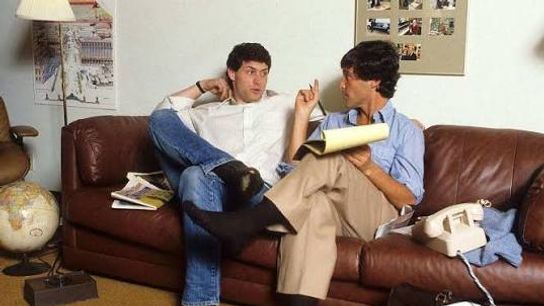
Courtesy of Leigh Steinberg
"We're trying to bring along a new generation of sports professionals with ethics and values," Steinberg said.
He still gets a thrill out of interacting with athletes.
He still finds new projects.
He recently put together something called MD Envoy—a sports agency-type organization for doctors—and signed 130 of them.
"I still get a thrill out of interacting with athletes, stimulating the best in them," Steinberg said. "I just picked a career that was everything I liked. I like to write. I like motion pictures. I like sports. I'm in the center of still trying to make a positive change in the world."
Steinberg reflected on his 15 years of sobriety.
"The end of life is simple," Steinberg said. "What you'll be known for is the quality of relationships. Were you there as a friend when the friend needed you? Were you there as a supportive father or a son? And then what did we do to leave the world better?"
The Super Bowl Party
Steinberg's Super Bowl party started in 1988 and has become a cultural institution—a convention of Americana where big business, big politics, big entertainment, and big sports all converge in the same city.
The 40th edition comes to Los Angeles in 2027.
"We do humanitarian awards, philanthropic awards for people who are team owners, general managers, coaches, current players, retired players," Steinberg said. "We pick a charity every year. Last year was the Urban League and we moved a family into the first home they'll ever own. We sent a water machine to Haiti that could purify water for 140,000 people a day."
They do a brain health summit—two hours of conversation bringing together the worldwide community concerned with athletic concussion.
They do a longevity lounge where you can see new methods and protocols for preventative healing—stem cells, hyperbaric oxygen, red light, nanob, BEMER, the whole cutting-edge series.
"The Super Bowls become a convention of Americana," Steinberg said. "I try to include that in an event that has ambient sound. So you actually talk. It's the antidote to the noisy, crowded, dark parties that go on all week. This one you can talk to people. We try to have connections and networking and bonding take place."
The City and the Man
When Steinberg thinks about what it means to be from Los Angeles, he thinks about reinvention.
"The culture—people from everywhere on the face of the earth—but there's an essential friendliness and caring to people in Southern California," Steinberg said. "This city does not judge you on your religion or your ethnicity. It allows you to reinvent yourself. It allows you to find a second start. It allows you the atmosphere in which anything's possible."
He pauses. Considers his words.
"That spirit of optimism, friendliness, support—I think is unique to Los Angeles."
It's also the spirit that saved him.
"I feel privileged to have been born in the place where people got their fresh start," Steinberg said. "I feel privileged to live in an area where you don't have to think about the weather. It's 72 degrees here maybe every day. It was a great gift to be born in Los Angeles."
Steinberg has been to the top; he has been to the bottom.
He has climbed back.
And now, at 77, he's watching his hometown do the same thing on a global stage.
"These events will elevate Los Angeles into the central role of being the biggest sports city in the world," Steinberg said.
The question at the heart of his life—and his book—isn't about sports. It's about redemption.
Do we believe people can change?
And more importantly, do we help them prove it?
The Final Word
Steinberg has never forgotten Crowe's words about Jerry McGuire's desire.
That was before the fall. Before the arrests. Before the bankruptcy. Before the long, lonely, arduous climb back.
But maybe that's the point.
Jerry Maguire was a fictional character. A movie about a man who lost everything and found his way back.
Leigh Steinberg is the real thing. The genuine article.
A man who lost everything but earned his way back.
Not in the script. Not on the screen.
In real life.
He has represented eight No. 1 overall picks, 64 first-rounders, 12 Hall of Famers. He has negotiated more than $4 billion in contracts.
He has raised nearly $1.3 billion for charity. He has trained thousands of young agents.
He has fought for concussion awareness when no one else would.
He has hosted 39 Super Bowl parties and counting.
But when you ask him what he's most proud of, he doesn't mention the contracts. He doesn't mention the Hall of Famers.
"Projects like Warrick Dunn's Homes for the Holidays," Steinberg said. "It changed people's lives. Projects like Warren Moon's Crescent Moon Foundation. Projects like the Troy Aikman Foundation that helps kids in hospitals. The athletes in aggregate have raised almost $1.3 billion for these programs. But it really is their involvement and having them be active in the community."
He pauses.
"I don't think much about legacy. But that I cared is probably about it."
Steinberg's life has taught him that resilience is not a word.
It's a decision.
And right now, Los Angeles is making that same decision. To host the world. To prove to itself that a city, like a man, can fall and still get back up.
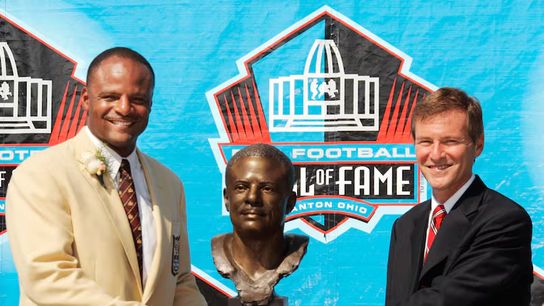
Courtesy of Leigh Steinberg
Leigh Steinberg presents Warren Moon for induction the the NFL Hall of Fame in Canton, Ohio
The World Cup. The Super Bowl. The Olympics.
Three years. Three events. One city.
"It establishes the centrality of Los Angeles as the hottest place in the world where people choose to assemble," Steinberg said. "I couldn't imagine being born and living anywhere else."
The view from his office still stretches across the Pacific like eternity's neighbor.
And after everything—the falls, the climbs, the comebacks—Leigh Steinberg is still here.
Still working. Still showing up. Still making a difference.
The question is not whether we'll face adversity. That part is inevitable.
The question is how we respond.
Steinberg chose to respond by climbing back. Los Angeles chose to respond by hosting the world.
Sometimes the best comeback isn't a single moment. It's a thousand small decisions made over a lifetime.
And sometimes the best city isn't the one that never falls. It's the one that keeps getting back up.